


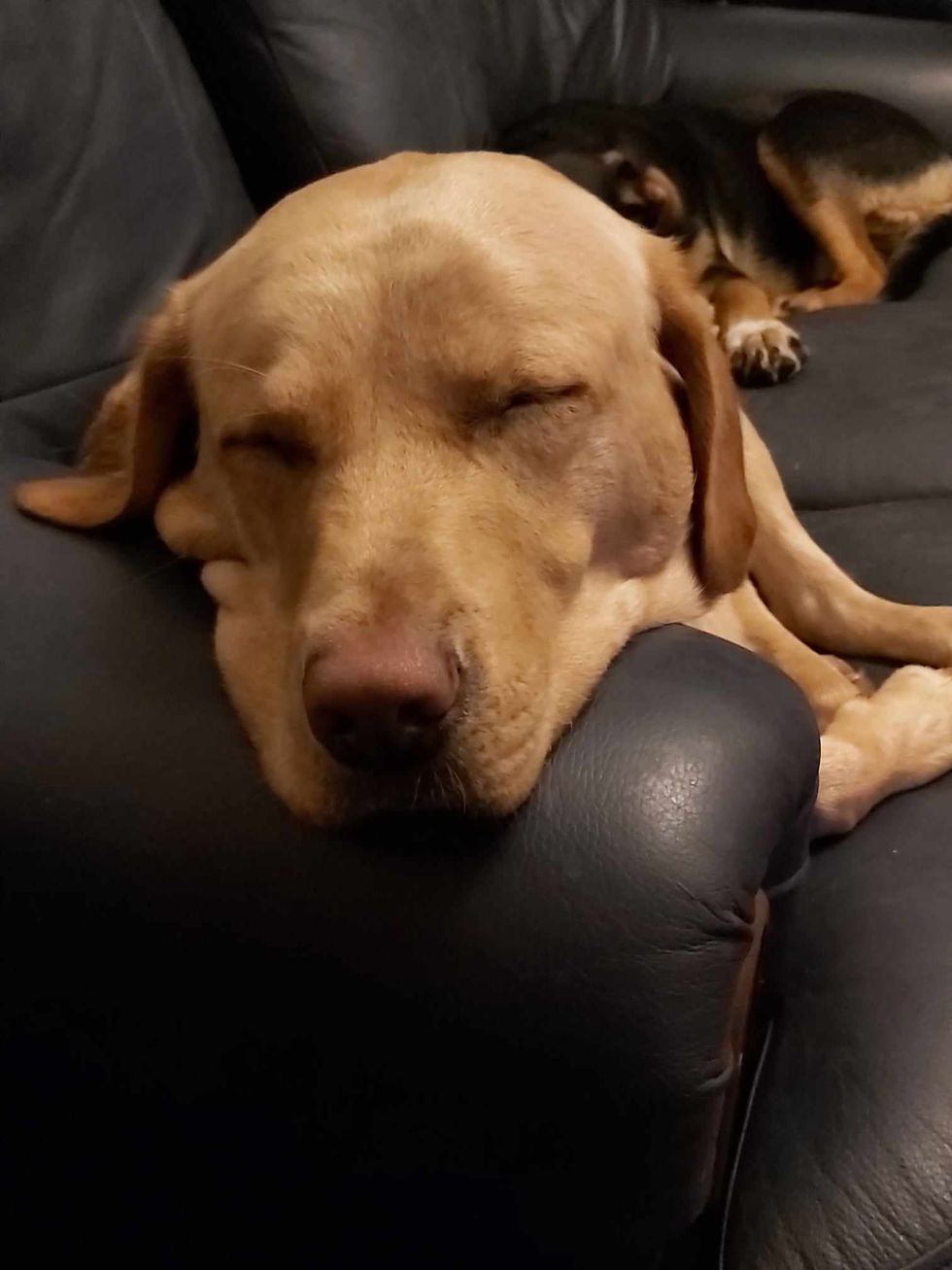
Let sleeping dogs.... Well, just let them sleep.

Updated: Aug 1
Ironically, I'm writing this because I can't sleep.
It got me thinking about something I spend a surprising amount of time talking to clients about: sleep. Not obedience. Not lead walking. Not recall. Sleep.
It isn't the most glamorous topic in dog training, but I genuinely believe it's one of the most overlooked pieces of the puzzle.
If you've ever told me your dog is reactive, anxious, constantly "on," or struggles to settle, one of my first questions is usually:
"How much quality sleep are they actually getting?"
Not how long they're lying down. Not how much time they're spending in their bed while keeping one eye on everything happening in the house. I mean proper, uninterrupted, restorative sleep.
Why Sleep Matters
Just like us, dogs process everything that happens to them while they sleep.
Sleep is when memories are consolidated, learning is reinforced, hormones are regulated and the brain essentially tidies itself up. Deprive any mammal of quality sleep and you're likely to see poorer decision making, reduced emotional control and increased stress.
Sound familiar?
A dog that's constantly running on an empty tank has less capacity to cope with the world around them.
They aren't choosing to be difficult.
They're simply running out of emotional battery.
What Does the Research Say?
The science around canine sleep is still developing, but it's becoming increasingly interesting.
Researchers have shown that dogs' experiences and their sleep influence each other. Dogs experiencing more activity or stress during the day often show altered sleep patterns, while poor sleep appears to have a negative affect on behaviour.
Other research has demonstrated that dogs continue processing information while asleep, with sleeping dogs showing different brain responses to emotional human and dog vocalisations. It highlights that sleep isn't simply "switching off"—the brain remains remarkably active.
There's also evidence that dogs sleep more deeply and efficiently when their owners are nearby, suggesting that feeling safe has a measurable impact on sleep quality.
None of these studies directly prove that poor sleep causes reactivity. Behaviour is far more complicated than that. Genetics, pain, previous experiences, environment and learning history all play significant roles.
But it does reinforce the idea that sleep is an important part of a dog's emotional wellbeing.
A Healthy Dose of Scepticism
Whenever we talk about research, it's worth remembering that studies all have limitations.
Many canine sleep studies involve relatively small numbers of dogs. Some are carried out in laboratory environments, while others rely on family dogs sleeping in unfamiliar settings with monitoring equipment attached. That's necessary to collect accurate data, but it's not quite the same as observing a dog sleeping in its own home. of course the ones done in peoples homes have there own issues. How many people truly know how much their dogs sleeps?
Funding also deserves a mention. Fortunately, much of the canine sleep research comes from universities and publicly funded research groups rather than pet food or pharmaceutical companies, reducing obvious commercial bias. That doesn't make every study perfect, but it's reassuring that many researchers have no product to sell.
Good science is rarely about one study proving everything. It's about lots of studies gradually building a bigger picture.
My Own Observation
I've worked with enough dogs now that one pattern keeps appearing.
The dogs that consistently get good quality sleep cope better with life.
Not perfectly.
Not magically.
But better.
Their recovery after stressful events is quicker.
Their reactions are often less intense.
They seem more capable of making good decisions instead of simply reacting.
It's something I see time and time again, particularly with rescue dogs who often arrive in their new homes already carrying a huge amount of stress.
Sometimes owners unintentionally prevent sleep without realising it.
The dog follows them from room to room.
Visitors keep saying hello.
Children want another cuddle.
The television is constantly on.
Someone gets up every twenty minutes.
The dog never truly switches off.
Imagine trying to sleep in the middle of a busy airport.
Eventually you'd become a little grumpy too.
Sleep and Reactivity
One thing many owners of reactive dogs report is that bad days often follow poor sleep.
While this isn't strong scientific evidence on its own, it's a remarkably consistent observation among trainers, behaviour professionals and owners alike. Discussions within the reactive dog community frequently describe dogs becoming noticeably more reactive, more anxious or less resilient after disrupted sleep.
That certainly matches what I see in practice.
If I'm working with a reactive dog, improving sleep isn't the entire behaviour plan.
But it is always part of it.
What Can You Do?
Sometimes improving sleep is surprisingly simple.
Give your dog somewhere quiet to rest where they won't be disturbed.
Resist the temptation to constantly interact with them.
Allow them to decompress after exciting walks or busy social events.
Remember that not every walk has to be packed with activity.
Respect that sleeping dogs really should be left sleeping.
Sometimes the best thing you can do for your dog's behaviour isn't another training session.
Sometimes it's letting them have a proper nap.
One of the reasons my Lab makes me smile is he's an absolute master at being horizontal.
If he doesn't know what to do, he'll have a nap.
People sometimes joke that he's lazy, but I don't see it that way at all. From the day he came home, we made good quality sleep part of his routine. Rest wasn't something he had to earn after being endlessly exercised or entertained—it was simply a normal part of life.
The result? He's learnt that it's okay to switch off. If nothing exciting is happening, he doesn't feel the need to pace around looking for trouble or invent his own entertainment. He'll quite happily stretch out somewhere comfortable and recharge until it's time for the next adventure.
I genuinely think that's one of the best life skills a dog can have.
Final Thoughts
Dog training often focuses on what we should do.
More enrichment.
More training.
More socialisation.
More exercise.
Sometimes the answer is actually less.
Less stimulation.
Less interruption.
More sleep
.
If there's one observation I'm increasingly confident making, it's this:
The more a dog sleeps, the better they're able to cope with life.
It might not solve every behavioural problem.
But I've yet to meet a dog whose behaviour got worse because they finally had the chance to get the rest they needed.


Comments