


Dogs Behaving (Very) Badly — What Are We Actually Watching?

Apparently, I'm in my bad guy era.
So naturally, I thought I'd pick a fight with one of Britain's best-known dog trainers.
Excellent.
Small independent dog trainer from South Wales takes on Dogs Behaving (Very) Badly.
This should end well.
Except there's a slight problem.
I'd never actually watched the programme.
Not until complete strangers started telling me I was doing everything completely wrong.
Apparently, I needed to watch Dogs Behaving (Very) Badly.
Apparently, the presenter knew better.
Apparently, because I didn't do things the way they did on television, I was doing it wrong.
Well...
That got my attention.
So I started watching them on YouTube.
And here's where this article gets awkward.
Because I don't actually hate Graeme Hall.
There. I've said it.
I know.
I'm supposed to be the bad guy.
I'm supposed to arrive wearing a black cloak, two large black dogs by my side and announce that everything Graeme Hall does is terrible.
Unfortunately, reality is rather less convenient.
I've watched a few of the programmes now, and there are things Graeme does that I think are perfectly sensible.
He rewards dogs.
He teaches owners.
He talks about accidental reinforcement.
He uses management.
He sometimes gives advice I'd happily give myself.
Bloody inconvenient.
But let's be honest.
Having watched the programme now, I've seen things I don't agree with.
Some things I'd do differently.
Some things I'd question.
Some things I wouldn't use with a dog myself.
But here's the thing:
I don't think that's a problem.
In fact, I think it's healthy.
If every dog trainer agreed about everything, I'd be considerably more worried.
Dog behaviour is complicated. Training is complicated. The evidence is constantly developing. Different professionals have different experiences, different areas of expertise and different ways of approaching a problem.
I'm perfectly comfortable saying:
"I wouldn't do that."
And I'm equally comfortable with another trainer looking at something I do and saying:
"I wouldn't do that either."
That's how professional discussion is supposed to work.
Where I think we get into trouble is when disagreement becomes:
"My way is right, therefore your way is wrong."
Or worse:
"This famous trainer does it, therefore you must do it too."
That's not critical thinking.
That's an appeal to authority.
And it's particularly strange when the authority being appealed to is a television programme that you've only seen for forty-five minutes.
I've got no problem with people disagreeing with me.
Please do.
Tell me why you think I'm wrong.
Show me the evidence.
Point me towards something I've missed.
If you've got a better explanation for what I'm seeing, I want to hear it.
Because I might learn something.
And if I can change my mind when better evidence comes along, that's not inconsistency.
That's the whole bloody point.
So yes, I've seen things on Dogs Behaving (Very) Badly that I don't like.
I've also seen things I think are perfectly reasonable.
And I've seen things where I'd simply want more information before deciding.
That's a much more interesting position than:
"Graeme Hall bad. Me good."
I'm not interested in that.
I'm interested in the discussion.
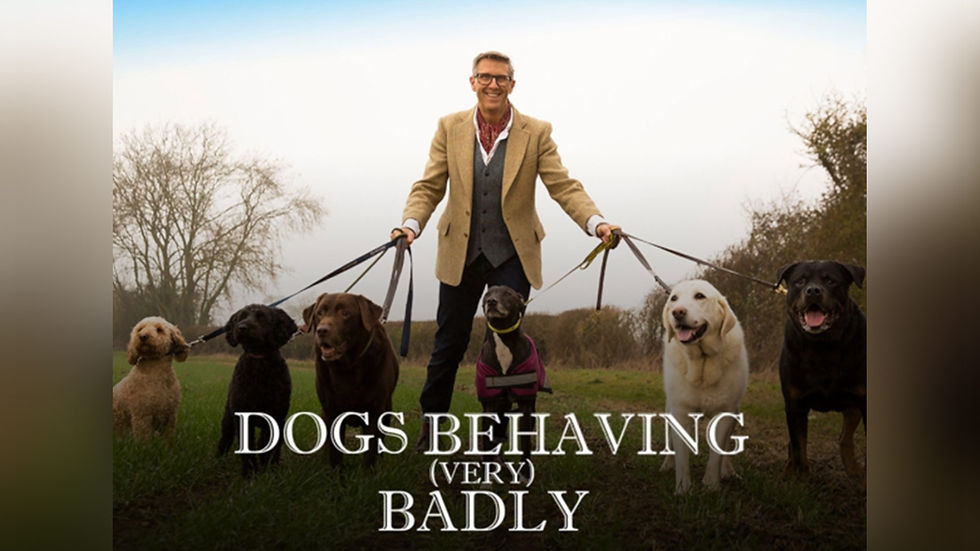
So this isn't going to be an article telling you that Graeme Hall is evil.
It isn't even an article telling you that he's a bad dog trainer.
It's about something much more boring.
Clarity.
Because one thing became increasingly obvious to me while watching the programme:
What you see on television isn't necessarily the whole story.
And that's something we should remember before using a television programme as ammunition against another dog owner.
Let me give you an example.
I've had people tell me I'm doing things wrong because they've seen me out working with a dog.
Recently, I was using a tracking harness and a long line.
Someone looking at that might quite reasonably think:
"Why is he letting the dog pull?"
Except...
I wasn't teaching the dog to walk nicely.
I was using a harness and long line because the dog was tracking.
That's what the equipment was for.
It wasn't a failed attempt at loose-lead walking.
It wasn't me accidentally teaching the dog to pull.
It was a completely different exercise.
And that's the first problem with judging dog training from a distance:
You don't necessarily know what you're looking at.
You can see the equipment.
You can see the dog.
You can see the handler.
But you don't necessarily know the goal.
You don't know the history.
You don't know what happened five minutes before the camera arrived.
And you certainly don't know what happens five minutes after it leaves.
What are we actually measuring when we decide that one person's dog training is "better" than somebody else's?
Is it how beautifully the dog walks past another dog?
How quickly it stops barking?
How obediently it sits?
How impressive the transformation looks on television?
Or are we also looking at whether the dog can calmly navigate the boring, everyday stuff that actually makes life with a dog work?
Getting into the car.
Waiting.
Coming when called.
Being able to disengage.
Recovering after something exciting.
Being able to cope with the world.
Living with its human without either of them constantly fighting each other.
Because dog training isn't a television trick.
And it's certainly not a competition.

The magic of television
Let's be fair to television.
Television has a job to do.
It has to entertain.
It has to tell a story.
And Dogs Behaving (Very) Badly is very good at doing that.
The programme's own production material describes it as finding "quick but long-lasting fixes" and presents each episode around difficult behaviour problems, intervention and improvement.
That's television.
But television has a particular problem when you're dealing with behaviour.
Behaviour doesn't come with a tidy beginning, middle and end.
A dog doesn't suddenly develop a problem when the camera crew arrives.
And it doesn't necessarily stop having one because the credits are about to roll.
Real behaviour change can involve weeks, months or years of learning history.
It involves repetition.
It involves management.
It involves setbacks.
It involves getting things wrong.
Sometimes spectacularly wrong.
And sometimes the biggest breakthrough is simply realising that the thing you thought was the problem...
wasn't actually the problem.
Television doesn't necessarily have time to show all of that.
And I'm not criticising the programme for that.
It's a television programme.
I'm saying that we shouldn't mistake the format for the entire reality of the case.
Before and after
One of the most powerful things television can do is show you a before and after.
Here's the dog doing X.
Here's the dog doing Y.
Look at the difference.
And sometimes the difference is genuinely impressive.
But there is a massive chunk of information missing from that story.
Everything in between.
What happened between those two scenes?
How many repetitions?
How many failed attempts?
How much management?
How much editing?
How many takes?
How much time passed?
What happened when the camera crew left?
Did the behaviour change because the dog learnt something new?
Did the environment change?
Did the handler change?
Was the trigger further away?
Was the dog more tired?
Was the dog more experienced with the situation?
Did the dog simply stop performing the behaviour?
These aren't accusations.
They're questions.
And they're questions worth asking whenever we watch any television dog-training programme.
Let's talk about thresholds
This is where things get a little more technical.
Sorry.
If you have a reactive dog and the trigger is 30 metres away, perhaps your dog can look at it and still eat.
At 25 metres, maybe they're staring.
At 20 metres, perhaps their body becomes tense.
At 15 metres, they're barking, lunging or trying to get away.
At that point, you're not necessarily looking at a dog who has simply forgotten its training.
You're looking at a dog whose emotional state has changed.
And once a dog is highly aroused or overwhelmed, expecting it to calmly process new information becomes considerably more difficult.
That's why distance can be such an important part of behaviour work.
Sometimes the most productive thing you can do is move away.
Not because you've failed.
Because you've recognised where the dog is capable of learning.
When "the dog stopped" isn't necessarily the same as "the dog changed"
This is one of the things I really want people to think about.
Imagine a dog barking and lunging at another dog.
The dog stops.
Looks quiet.
No barking.
No lunging.
Success?
Maybe.
But what happened internally?
We can't directly see a dog's emotional state.
We have to infer it from behaviour and context.
A dog that has learnt:
"That other dog isn't a threat. I can relax."
is a very different proposition from a dog that has learnt:
"I can't do anything about this situation."
Both dogs might be standing quietly.
From a distance, they can look identical.
And that's why simply measuring whether a behaviour has stopped can be misleading.
Behavioural suppression and emotional change aren't necessarily the same thing.
That doesn't mean every quiet dog is secretly terrified.
It doesn't mean every correction causes suppression.
And it certainly doesn't mean that every trainer who gets a dog to stop doing something has done something terrible.
It means we should look at the whole dog.
Watch the dog
This, for me, is the most important part.
Don't just watch the trainer.
Watch the dog.
Look at the ears.
The eyes.
The mouth.
The breathing.
The posture.
The weight distribution.
The tail.
The movement.
The direction the dog is facing.
Whether the dog can disengage.
Whether it can take food.
Whether it can respond to the handler.
Whether it can explore.
Whether it can sniff.
Whether it chooses to approach or avoid.
And most importantly:
What happens to all of those things as the situation changes?
A lip lick on its own doesn't prove a dog is terrified.
A yawn doesn't automatically mean stress.
A wagging tail doesn't automatically mean happiness.
A dog taking a treat doesn't automatically mean it's comfortable.
Body language is contextual.
That's precisely why I don't want to make sweeping claims about individual clips without looking carefully at the footage.
If we're going to criticise what somebody is doing, we should be able to explain what we actually observed.
Not what we assume happened.
Not what somebody on Facebook told us happened.
And not what fits the argument we wanted to make before we watched the video.
Before anyone starts shouting...
No, this isn't me saying you should never tell a dog "no".
I'm not saying everything other than food rewards is abuse.
I'm not saying dogs should be allowed to do whatever they like.
And I'm definitely not starting a religious war about whether a piece of equipment is inherently good or evil.
Dog training isn't a cult.
There are different tools.
Different techniques.
Different dogs.
Different circumstances.
And different professional opinions.
The interesting question isn't simply:
"Did the trainer use a reward?"
It's:
"What effect did the whole interaction have on the dog, and what did the dog learn from it?"
Management isn't failure
This is another thing television can make look deceptively simple.
Sometimes you don't train through a situation.
Sometimes you manage it.
You put distance between the dog and the trigger.
You change the route.
You use a long line.
You use a harness.
You prevent rehearsal of unwanted behaviour.
You don't take your dog into the middle of a situation they're completely unable to cope with just because you want to prove that your training works.
That's not failure.
That's training intelligently.
But management isn't necessarily a cure either.
If I stop a dog rehearsing a behaviour by preventing access to the trigger, I've achieved something valuable.
I've made life safer.
I've reduced rehearsal.
I've potentially lowered stress.
But I haven't necessarily changed the underlying emotional response.
That's an important distinction.
And the owner?
Here's another uncomfortable one.
Sometimes owners absolutely do contribute to a dog's behaviour.
We can accidentally reinforce things.
We can create patterns.
We can reward behaviours without realising it.
We can respond inconsistently.
We can misunderstand what our dogs are communicating.
I've done it.
You've probably done it.
We're human.
But there's a danger in making "the owner caused it" the explanation for everything.
Dogs bring their own history to the table.
Genetics.
Early experiences.
Learning history.
Pain.
Fear.
Frustration.
Arousal.
Environment.
Previous reinforcement.
Previous punishment.
And sometimes we simply don't know.
A good trainer shouldn't need the owner to be the villain in order to make themselves the hero.
Cameras change things
There's another factor worth remembering.
The camera itself is part of the environment.
There may be people around.
Equipment.
Lighting.
Sound.
Crew.
Movement.
Different locations.
Different smells.
Different expectations.
Different behaviour from the humans.
Even Graeme Hall has acknowledged that cameras can make some anxious dogs more difficult and that sometimes the camera has to be introduced slowly.
That's hardly surprising.
Imagine somebody turned up at your house with six strangers, cameras, microphones and bright lights while you were already having a terrible day.
You might behave slightly differently too.
So when we watch a dog behaving on television, we need to remember that we're not watching the dog in a laboratory with all variables controlled.
We're watching a dog in a television production.
That doesn't make the footage useless.
Far from it.
It just means context matters.
The one-day miracle
One of the things that makes these programmes so satisfying is the apparent speed.
Problem.
Trainer arrives.
Training happens.
Dog improves.
Everyone goes home happy.
And sometimes, yes, a relatively small intervention really can make a dramatic difference.
Especially when the owners have been doing something that accidentally maintains the problem.
Change the human behaviour and you can sometimes change the dog's behaviour remarkably quickly.
But there's a difference between:
"We found something that works in this situation."
and
"The problem is permanently solved."
Even Avalon describes the programme in terms of quick but long-lasting fixes, with follow-up contact with owners after filming.
That's a claim worth understanding in context.
Because what I want to know isn't just:
"Did the dog behave differently while the cameras were there?"
I want to know:
"What happened six months later?"
And then there's the question of help
This is where things get particularly interesting.
I've seen claims online that external trainers have been involved in helping with cases before or during filming.
Some of those claims are anecdotal.
Some are difficult to independently verify.
So I'm not going to present internet rumours as fact.
But there is at least one publicly documented example from 2024 in which a programme researcher contacted an external trainer about filming a demonstration involving training a dog not to respond to a telephone ringtone.
The trainer who published the correspondence subsequently described being told that the purpose was to demonstrate the approach to Graeme for use with the featured dog.
That is an interesting piece of information.
But it is one account, and it doesn't prove the much broader claims that have circulated online about how the programme is produced.
And that's precisely why I'm asking questions rather than declaring conclusions.
There is absolutely nothing wrong with asking for help
Let me be really clear about this.
A consultant isn't the problem.
I occasionally seek advice from a highly qualified behaviourist.
Why?
Because I'm not an expert in everything.
And I don't want to pretend that I am.
If I have a case that's outside my experience, I'd much rather say:
"I don't know. Let me speak to somebody who knows more."
That's not weakness.
That's professionalism.
Good trainers don't have to know everything.
They need to know when they don't know enough.
So if Dogs Behaving (Very) Badly uses behaviourists, trainers, vets or other specialists behind the scenes, I don't have a problem with that.
In fact, I'd probably be pleased.
The question isn't:
"Does Graeme Hall get help?"
The question is:
"Does the viewer know when outside expertise materially contributes to what they're watching?"
If somebody's expertise has helped shape a training plan, demonstrated a technique, assessed a behaviour problem or influenced the outcome, I'd argue that acknowledgement is a good thing.
It doesn't make the presenter look less competent.
Quite the opposite.
It shows that good professional practice sometimes means knowing when to bring another person into the room.
What happens when the cameras leave?
This is probably the biggest question television can't easily answer.
We see the transformation.
We see the happy ending.
But behaviour doesn't stop existing when filming finishes.
What happens when the dog encounters the trigger six weeks later?
What happens on a bad day?
What happens when the owners are tired?
What happens when the dog is ill?
What happens when something completely unexpected happens?
What happens when the original setup isn't available?
And what happens when the dog has a choice?
That's where I think the real measure of behaviour change lies.
Not:
"Did the dog stop?"
But:
"Can the dog cope?"
So, is Graeme Hall a bad dog trainer?
I don't know.
And that's the point.
I'm not qualified to make that sweeping judgement from a television programme.
Neither, frankly, is a random bloke who has watched three episodes and decided that you're doing everything wrong.
What I can do is question what I'm seeing.
I can question the editing.
I can question the framing.
I can question whether a quiet dog is necessarily a relaxed dog.
I can question whether management is being presented as training.
I can question whether a one-day intervention is being presented as a complete behavioural solution.
I can ask what happens after filming.
I can ask whether external professionals contribute.
And I can ask whether the viewer has enough information to understand what they're actually watching.
Those aren't attacks.
They're reasonable questions.
The villain's verdict
So here I am.
The supposedly terrible dog trainer from South Wales.
The bloke who apparently needs to watch television to learn how to train dogs.
And after actually watching it...
I haven't discovered that Graeme Hall is some sort of evil mastermind.
Dog training is complicated.
Behaviour is complicated.
Television is complicated.
And certainty is often much easier to sell than nuance.
That's why I don't want you to watch Dogs Behaving (Very) Badly and automatically believe everything you see.
But I also don't want you to watch it and automatically believe everything I say.
Watch the dog.
Look at the context.
Ask what happened before.
Ask what happened afterwards.
Ask what the dog learnt.
Ask whether the behaviour changed because the dog understood the situation differently...
...or because the dog simply stopped trying.
And if you don't know?
Say you don't know.
Because apparently that's becoming controversial.
A final thought
The dog doesn't care who has the bigger Facebook following.
It doesn't care who has the television programme.
It doesn't care who has the flashiest website.
It doesn't care whether the trainer calls themselves a behaviourist, a dog whisperer, a master trainer or the bloody Dogfather.
It cares about whether the world makes sense.
Whether it's safe.
Whether it can cope.
Whether its human understands it.
And whether the person holding the lead is listening.
That's the bit I'm interested in.
Not winning an argument.
Not destroying somebody's reputation.
Not proving that my way is the only way.
Just asking a rather awkward question:
What are we actually watching?
Because if I'm going to spend my villain era doing anything...
I might as well spend it asking awkward questions.
I'm a villain, not a liar.
A note from the production team
At the time of publication, Ruff Start Dog Training has contacted the production team behind Dogs Behaving (Very) Badly to ask for clarification about the programme's use of external trainers, behaviour professionals and other canine specialists, and about how training and behaviour cases are assessed and presented on the programme.
[SPACE RESERVED FOR THE PRODUCTION COMPANY'S RESPONSE]
If a response is received, it will be reproduced or summarised here accurately and in context.
Because if I'm going to ask for clarity from somebody else, I should probably practise what I preach.


Comments