


Jealous. FOMO. Or just “Oi, what are they getting that I'm not?”

“He's jealous.”
“She gets terrible FOMO.”
You've probably heard both.
Perhaps you've even said them yourself.
Your dog is asleep on the sofa. Completely unconscious. Possibly snoring.
You stand up and walk towards the kitchen.
Suddenly:
DOG ACTIVATED.
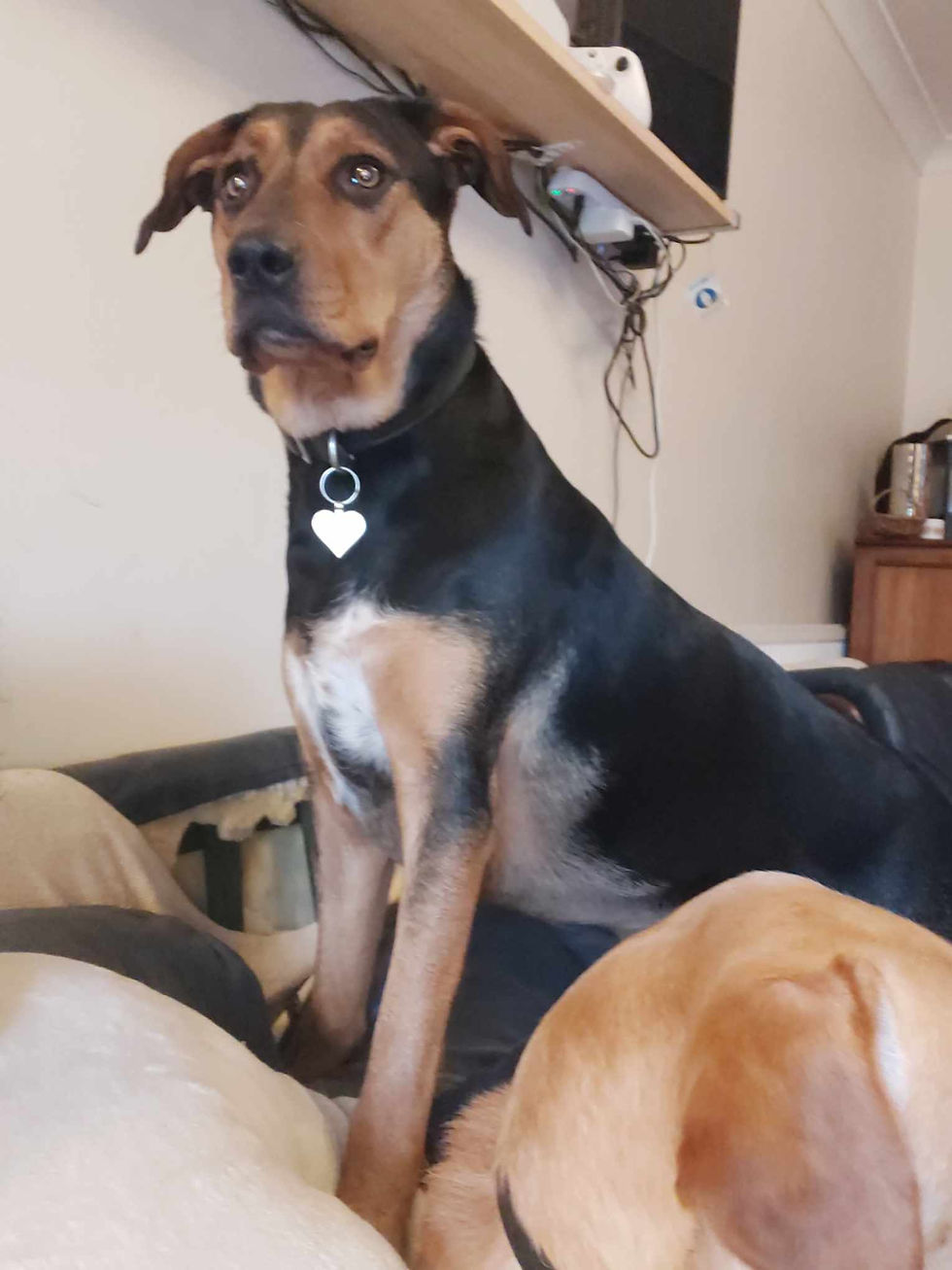
were asleep thirty seconds ago, but apparently there is now a very real possibility that you are doing something without them.
And that, frankly, is unacceptable.
You sit down to stroke one dog.
The other dog appears.
Immediately.
From another room.
Possibly from another postcode.
“Excuse me. I believe you are distributing strokes and I was not consulted.”
Is that jealousy?
Your dog sees another dog getting a treat and suddenly decides that they too have an urgent and previously undiscovered interest in treats.
FOMO?
But, as with so many words in dog training, the interesting question isn't:
“Is my dog jealous?”
It's:
“What exactly is my dog doing, and why might they be doing it?”
The trouble with calling it jealousy
Jealousy is a word we understand from our own lives.
We know roughly what we mean when we say we're jealous.
Someone else has something we want.
Someone else is receiving attention we value.
We feel threatened by the possibility of losing access to something important.
But when we look at our dogs, we need to be careful.
If your dog pushes between you and another dog when you're giving them attention, we might call that jealousy.
But what do we actually know?
Perhaps the dog has learned:
Other dog gets fuss → I might miss out → get involved immediately.
Perhaps they're competing for access to a valued resource.
And yes, you can be the resource.
Congratulations.
After all these years of believing you were the boss, it turns out you may simply be a rather slow-moving food dispenser and professional ear scratcher.
But competition for access isn't the same thing as jealousy in the full human sense.
The label might be a useful shorthand.
It isn't an explanation.
“He gets jealous when I stroke another dog”
But let's look at what happens.
You stroke Dog A.
Dog B comes over and nudges your hand.
You stop stroking Dog A and stroke Dog B.
Dog B has learned something.
Nudging works.
Next time, you stroke Dog A.
Dog B nudges again.
And again.
Pretty soon we might say:
“Oh, he's jealous.”
But from a learning perspective, we may simply have a dog who has discovered an extremely effective way of getting access to something they value.
You.
Or rather, your hands.
Let's not get carried away.
And then there's FOMO
Fear Of Missing Out.
A very human term that has somehow become extremely useful when describing certain dogs.
You get up?
They're coming.
You go to the toilet?
They're coming.
You open the fridge?
ABSOLUTELY COMING.
You move a chair six inches?
Well, clearly something is happening and they need to investigate.
Immediately.
Some dogs genuinely seem to believe that if they aren't physically present for every event in the house, they may miss the greatest thing that has ever happened.
The problem is that FOMO doesn't actually tell us what's going on either.
A dog following you everywhere might simply have learned that you predict good things.
You go to the kitchen?
Food sometimes happens.
You go outside?
Walks sometimes happen.
You pick up your keys?
Very suspicious.
You put shoes on?
WE KNOW WHAT THIS MEANS.
The dog isn't necessarily experiencing an existential fear of missing the latest social event.
They may simply have become very good at predicting that your movements lead to interesting things.
“But he has to be involved in everything!”
Yes.
Some dogs really do.
At least, that's what it feels like.
But again, let's ask why.
Is the dog curious?
Are they anticipating something?
Have they learned that following people predicts good things?
Are they worried about being left behind?
Are they unable to settle when separated?
Are they seeking social contact?
Are they bored?
Is this simply a dog who has decided that supervising the household is now their full-time occupation?
Those are very different possibilities.
And they may require very different responses.
The danger of the cute label.
This is where I think words like jealous and FOMO can occasionally cause problems.
Because the label can make us laugh and stop us investigating.
“Aww, he's jealous.”
But what if the dog is becoming increasingly tense around another dog?
What if they're guarding access to the owner?
What if they're repeatedly interrupting interactions?
What if their behaviour escalates from nudging to blocking, growling or snapping?
Now we need to stop laughing at the jealousy and start looking at the behaviour.
Equally:
“Oh, he's got terrible FOMO.”
Sounds funny.
But what if the dog genuinely cannot settle when their person leaves the room?
What if they panic when excluded?
What if they're following because they're worried?
What if there are separation-related issues developing?
Again, the label shouldn't end the investigation.
It should start it.
You can love something and still not want to share it
This is probably where our language gets most interesting.
Dogs can value access to things.
Food.
Toys.
Space.
People.
And sometimes they may behave differently when another individual appears to threaten their access to those things.
That doesn't automatically mean:
JEALOUSY!
But neither do we have to pretend nothing is happening.
The behaviour is real.
The competition may be real.
The value of the resource is real.
What we need to avoid is jumping straight from:
“My dog came between me and another dog.”
to:
“My dog is jealous because he loves me more than anything.”
Sorry.
Your dog may love you.
But there's also a reasonable chance you've simply got the best lap in the house.
So should we stop using the words?
Not necessarily.
I don't think language needs to become so clinical that nobody can talk normally.
If you tell me your dog is jealous, I know roughly what you mean.
If you tell me they've got FOMO, I can probably picture them following you to the bathroom.
Again.
But when we're trying to understand or change behaviour, I'd want to look deeper.
Instead of:
“He's jealous.”
Ask:
What does he actually do when someone else gets attention?
Instead of:
“She's got FOMO.”
Ask:
What happens when she doesn't follow?
Can she settle?
Does she choose to stay behind sometimes?
Does she become worried when excluded?
What does she think she's missing?
Because the answer matters.
Maybe your dog isn't jealous.
Maybe they're learning.
Maybe they're competing for access to something valuable.
Maybe they're worried about losing it.
Maybe they've learned that barging in gets results.
Maybe they're simply thinking:
“Hang on. There were treats. I saw treats. Why wasn't I invited?”
So perhaps your dog doesn't have FOMO.
Maybe they're curious.
Maybe they're anticipating something good.
Maybe you've accidentally taught them that every time you stand up, something exciting happens.
Or maybe they simply don't trust you to go into another room without opening a packet of ham.
And honestly?
After years of living with humans...
that's probably not an entirely unreasonable concern.

Comments